返回总目录
Variant Readings of the Quran
Variant Readings of the Quran
Sam Shamoun
The following list of Quranic variant readings is compiled from several Muslims
sources. These sources provide evidence that there were many conflicting readings
of the Quran in circulation, destroying the Muslim myth and lie that the Quran
is a perfectly compiled book. The facts clearly show that the Quran underwent
textual corruption via additions, omissions and conflicting variant readings,
casting doubt on its integrity.
We begin with Sunan Abu Dawud, Book 30, Dialects and Readings of the Qur'an
(Kitab Al-Huruf Wa Al-Qira'at). We are using the translation done by Prof.
Ahmad Hasan (Sh. Muhammad Ashraf Publishers, Booksellers & Exporters; Lahore,
Pakistan, 1984), Volume III, pp. 1113-1121. Some of these ahadith can also be found
online at:
http://www.usc.edu/dept/MSA/fundamentals/hadithsunnah/abudawud/030.sat.html
Zaid b. Thabit said that the Prophet (may peace be upon him) used to read:
"Not equal are those believers who sit (at home) and receive no hurt (ghairu
uli’l-darari) but the narrator Sa‘id did not say the words "used
to read." (Number 3964)
The translator states:
3377. Qur’an, iv. 95
The word ghair in this verse has three variants, namely, ghaira, ghairu
and ghairi. This can be read with three vowels. Ibn Kathir, Abu ‘Amr, Hamzah,
and ‘Asim read it ghairu, with short vowel u. Nafi’, Ibn ‘Amr
and al-Kisa’i read it ghaira with short vowel a. A rare reading goes
ghairi with a short vowel i (‘Awn al-Ma’bud, IV, 57).
(p. 1115)
‘Atiyyah b. Sa’d al-‘Awfi said: I recited to ‘Abd Allah b.
‘Umar the verse: "It is Allah Who created you in a state of (helplessness)
weakness (min da ‘fin)." He said: (Read) min du‘fin.
I recited it to the Apostle pf Allah (may peace be upon him) and he gripped me as
I gripped you. (Number 3967)
Abu Sa‘id said: The Prophet (may peace be upon him) read the verse mentioned
above, "min du’fin." (Number 3968)
The translator writes:
3380. Qur’an xxx. 54. The word du‘f in this verse has two readings:
Asim and Hamzah read it da‘fin with short vowel a, and Hafs and others
read it du‘fin with short vowel u. The latter is a stronger reading.
(Ibid.)
Ubayy b. Ka b said: "Say, in the bounty of Allah, and in His mercy - in that let
you rejoice." (Number 3969)
Footnote 3381 reads:
... Qur’an x. 58. In this verse the word fa‘l-yafrah has two
readings: Abu Ja‘far and Ibn ‘Amir and others read it fa‘l-yafrahu
(let them rejoice); and Ya‘qub read it fa‘l-tafrahu (let you rejoice). (Ibid.)
Ubayy (b. Ka‘b) said: The Prophet (may peace be upon him) read the verse:
"Say: In the bounty of Allah and in his mercy - in that let you rejoice: that is
better than the wealth you hoard." (Number 3970)
The translator claims:
3382. Qur’an, x. 58. In this verse the word tajma‘un has two readings:
yajma‘un (they hoard) and tajma‘un (you hoard). (p. 1116)
Asma, daughter of Yazid, said that she heard the Prophet (may peace be upon him) read
the verse: "He acted unrigteously." (innahu ‘amila ghaira salih).
(Number 3971)
Shahr ibn Hawshab said: I asked Umm Salamah: How did the Apostle of Allah (may peace be
upon him) read this verse: "For his conduct is unrighteous" (innahu 'amalun
ghairu salih)? She replied: He read it: "He acted unrighteously" (innahu
'amila ghaira salih). (Number 3972)
The translator writes in fn. 3383:
... Qur’an, xi. 46. The well-known reading of this verse is innahu
‘amalun ghairu salih [For his conduct is unrighteous]. Al-Kisa‘i and
Ya‘qub read ‘amila (acted) while others read ‘amalun
(act or conduct). (Ibid.)
Ibn ‘Abbas said: Ubayy b. Ka‘b made me read the following verse as the
Apostle of Allah (may peace be upon him) made him read: "in a spring of murky
water" (fi ‘ainin hami’ atm) with short vowel a after h.
(Number 3975)
Again:
3385. Qur’an, xviii. 86. The word hami’ah in this verse has two
readings: the well-known reading is hami’ah (murky water). Ibn ‘Amr,
Hamzah, al-Kisa‘i and Abu Bakr read it hamiyah (warm water). (Ibid.)
Abu Sa‘id al-Khudri reported the Prophet (may peace be upon him) as saying: A man
from the ‘illiyyun will look downwards at the People of Paradise and Paradise
will be glittering as if it were a brilliant star. He (the narrator) said: In this way the
word durri (brilliant) occurs in the tradition, i.e. the letter dal (d)
has short vowel u and it has no hamzah (’). Abu Bakr and ‘Umar
will be of them and will have some additional blessings. (Number 3976)
We are told in fn. 3387:
... Qur’an, xxiv. 35. The word durri in this verse has three readings:
durri, dir’i and dur’i. The well-known reading is durri,
from durr meaning pearl. Abu ‘Amr and al-Kisa’i read dir’i
and Hamzah and Abu Bakr read dur’i from dar’un meaning to avert. (Ibid.)
‘Abd Allah (b. Mas‘ud) said: The Apostle of Allah (may peace be upon him)
made me read the verse "It is I who give (all) sustenance, Lord of power, steadfast
(for ever)." (Number 3982)
Fn. 3396 indicates:
... Qur’an, li. 58. The well-known reading of this verse is "For Allah is
He Who gives (all) sustenance, Lord of power, steadfast (for ever)." The reading of
this verse as mentioned in this tradition is found in the copy of the Qur’an of Ibn
Mas‘ud. But this is against the agreed reading. (Ibid., p. 1118)
‘Abd Allah (b. Mas‘ud) said: The Prophet (may peace be upon him) used to read
the verse "Is there any that will receive admonishment (muddakir)?" that
is with the doubling of consonant [(dal)(d)].
Abu Dawud said: The word may be pronounced as mim (m) with short vowel u,
(dal)(d) with short vowel a and kaf (k) with short
vowel i. (Number 3983)
The translator notes:
3397. Qur’an, liv. 15. The word muddakir was originally mudhakir.
According to grammatical rules, it has been changed into muddakir. Some read it
mudhdhakir. But this is a rare reading. (Ibid.)
Ibn al-Musayyab said: The Prophet (may peace be upon him), Abu Bakr, ‘Umar and
‘Uthman used to read: ‘‘maliki yawmi ‘l-din ("master of
the Day of Judgment"). The first to read maliki yawmid-din was Marwan.
(Number 3989)
Shaqiq said: Ibn Ma‘sud read the verse: "Now come thou" (haita laka).
Then Shaqiq said: We read it, "hi ‘tu laka" (I am prepared for thee).
Ibn Ma‘sud said: I read it as I have been taught; IT IS DEARER TO ME. (Number
3939)
Al-Bukhari also alludes to certain variants, some of which include:
Addition to Sura 92
Surah 92:3 reads:
YUSUFALI: By (the mystery of) the creation of (wama khalaqa)
male and female;-
PICKTHAL: And Him Who hath created male and female,
SHAKIR: And the creating of the male and the female,
Yet according to the following hadiths, the phrase "by Him who created (ma
khalaqa)" is an addition to the text that some like Ibn Masud said shouldn't be
there:
Narrated Alqama:
I went to Sham and was offering a two-Rak'at prayer; I said, "O Allah! Bless me
with a (pious) companion." Then I saw an old man coming towards me, and when he came
near I said, (to myself), "I hope Allah has given me my request." The man asked
(me), "Where are you from?" I replied, "I am from the people of Kufa."
He said, "Weren't there amongst you the Carrier of the (Prophet's) shoes, Siwak and
the ablution water container? Weren't there amongst you the man who was given Allah's
Refuge from the Satan? And weren't there amongst you the man who used to keep the
(Prophet's) secrets which nobody else knew? How did Ibn Um 'Abd (i.e. 'Abdullah bin
Mas'ud) use to recite Surat-al-lail (the Night: 92)?" I recited:--
"By the Night as it envelops By the Day as it appears in brightness. And by
male and female." (92.1-3) On that, Abu Darda said, "BY ALLAH, the
Prophet made me read the Verse in this way after listening to him, but these people (of
Sham) TRIED THEIR BEST to let me say something different." (Sahih Al-Bukhari,
Volume 5, Book 57, Number 105)
Narrated Ibrahim:
The companions of 'Abdullah (bin Mas'ud) came to Abu Darda', (and before they arrived
at his home), he looked for them and found them. Then he asked them,: "Who among
you can recite (Qur'an) as 'Abdullah recites it?" They replied, "All of
us." He asked, "Who among you knows it by heart?" They pointed at 'Alqama.
Then he asked Alqama."How did you hear 'Abdullah bin Mas'ud reciting Surat Al-Lail
(The Night)?" Alqama recited:
‘By the male and the female.’ Abu Ad-Darda said, "I
TESTIFY that I heard the Prophet reciting it likewise, but these people want me to recite
it:--
‘And by Him Who created male and female.’ BUT BY ALLAH, I WILL NOT
FOLLOW THEM." (Sahih Al-Bukhari, Volume 6, Book 60, Number 468; see also Volume
5, Book 57, Number 85)
Missing Verse on the State of Martyrs
Narrated Anas bin Malik:
(The tribes of) Ril, Dhakwan, 'Usaiya and Bani Lihyan asked Allah's Apostle
to provide them with some men to support them against their enemy. He
therefore provided them with seventy men from the Ansar whom we used to
call Al-Qurra' in their lifetime. They used to collect wood by daytime and pray
at night. When they were at the well of Ma'una, the infidels killed them by
betraying them. When this news reached the Prophet, he said Al-Qunut for
one month In the morning prayer, invoking evil upon some of the 'Arab tribes,
upon Ril, Dhakwan, 'Usaiya and Bani Libyan. We used to read a verse
of the Qur'an revealed in their connection, but later the verse was cancelled.
It was: "convey to our people on our behalf the information that we
have met our Lord, and He is pleased with us, and has made us pleased."
(Anas bin Malik added:) Allah's Prophet said Qunut for one month in the
morning prayer, invoking evil upon some of the 'Arab tribes (namely), Ril,
Dhakwan, Usaiya, and Bani Libyan. (Anas added:) Those seventy Ansari men
were killed at the well of Mauna. (Sahih Al-Bukhari, Volume 5, Book 59,
Number 416)
Renowned Muslim historian and commentator al-Tabari makes mention of this passage:
According to Ishaq- Anas b. Malik: God revealed concerning them as part of
the Qur'an, "Tell our people of us. Verily we have met our Lord, and He has
been pleased with us and we have been pleased with Him." Later it was
abrogated and removed from the Qur'an, but for a time we had recited it.
God then revealed, "Think not of those, who are slain in the way of Allah, as
dead. Nay, they are living. With their Lord they have provision, jubilant."
... Anas says: We used to recite, as part of what abrogated, "Tell our
brethren of us, that we have met our Lord, and he has been pleased with us
and we have been pleased with him." (The History of Al-Tabari: The Foundation
of the Community, translated by M. V. McDonald, Annotated by W. Montgomery
Watt [State University of New York Press, Albany 1987], pp. 155-156)
Missing Verse On Stoning
Narrated Ibn 'Abbas:
'Umar said, "I am afraid that after a long time has passed, people may say,
"We do not find the Verses of the Rajam (stoning to death) in the Holy Book,"
and consequently they may go astray by leaving an obligation that Allah has revealed. Lo!
I confirm that the penalty of Rajam be inflicted on him who commits illegal sexual
intercourse, if he is already married and the crime is proved by witnesses or pregnancy or
confession." Sufyan added, "I have memorized this narration in this way."
'Umar added, "Surely Allah's Apostle carried out the penalty of Rajam, and so did we
after him." (Sahih Al-Bukhari, Volume 8, Book 82, Number 816)
... In the meantime, 'Umar sat on the pulpit and when the callmakers for the prayer
had finished their call, 'Umar stood up, and having glorified and praised Allah as He
deserved, he said, "Now then, I am going to tell you something which (Allah) has
written for me to say. I do not know; perhaps it portends my death, so whoever understands
and remembers it, must narrate it to the others wherever his mount takes him, but if
somebody is afraid that he does not understand it, then it is unlawful for him to tell
lies about me. Allah sent Muhammad with the Truth and revealed the Holy Book to him,
and among what Allah revealed, was the Verse of the Rajam (the stoning of married person
(male & female) who commits illegal sexual intercourse, and we did recite this Verse
and understood and memorized it. Allah's Apostle did carry out the punishment of stoning
and so did we after him.
I am afraid that after a long time has passed, somebody will say, ‘By Allah, we do
not find the Verse of the Rajam in Allah's Book,’ and thus they will go astray by
leaving an obligation which Allah has revealed. And the punishment of the Rajam is to
be inflicted to any married person (male & female), who commits illegal sexual
intercourse, if the required evidence is available or there is conception or confession. And
then we used to recite among the Verses in Allah's Book: ‘O people! Do not
claim to be the offspring of other than your fathers, as it is disbelief (unthankfulness)
on your part that you claim to be the offspring of other than your real father’ ..."
(Sahih Al-Bukhari, Volume 8, Book 82, Number 817; see also Vol. 9, No. 424)
Notice that this hadith mentions an additional verse, besides the one on stoning,
which is not found in the Quran!
Missing Part On Muhammad's Fatherhood
The late Muslim translator Abdullah Yusuf Ali records that Ubayy b. Ka‘b had an
additional statement in his reading of S. 33:6. The Uthmanic text presently reads:
"The prophet is closer to the believers than their own selves, and his wives are
their mothers."
Yet Ubay's codex read:
"The prophet is closer to the believers than their own selves, and he is a
father to them, and his wives are their mothers."
Hence, Yusuf Ali states:
"In spiritual relationship the Prophet is entitled to more respect and
consideration than blood-relations. The Believers should follow him rather than their
fathers or mothers or brothers, where there is conflict of duties. He is even nearer -
closer to our real interests - than our own selves. IN SOME QIRAATS, LIKE THAT OF
UBAI IBN KA'B, occur also the words ‘and he is a father to them,’ which imply
his spiritual relationship and connect on with the words, ‘and his wives are
their mothers.’ Thus his spiritual fatherhood would be contrasted pointedly
with the repudiation of the vulgar superstition of calling any one like Zaid ibn Haritha
by the appellation Zaid ibn Muhammad (xxxiii. 40): such an appellation is really
disrespectful to the Prophet." (Ali, The Holy Qur'an, p. 1104, fn. 3674)
A renowned Muslim scholar of the past candidly admitted:
... An unusual reading of the Qur'an includes, "He is a father to them,"
but it is no longer recited since it is AT VARIANCE with the version of
'Uthman. (Muhammad Messenger of Allah (Ash-Shifa of Qadi 'Iyad),
Qadi 'Iyad Musa al-Yahsubi, translated by Aisha Abdarrahman Bewley [Madinah
Press, Inverness, Scotland, U.K. 1991; third reprint, paperback], pp. 29-30;
bold and capital emphasis ours)
This scholar's comment presupposes that the Uthmanic text was more
reliable, a position which is not supported by the Islamic data.
Missing Part On Asr Prayer
Yahya related to me from Malik from Zayd ibn Aslam from al-Qaqa ibn Hakim that Abu
Yunus, the mawla of A'isha, umm al-muminin said, "A'isha ordered me to write out a
Qur'an for her. She said, ‘When you reach this ayat, let me know, "Guard the prayers
carefully and the middle prayer and stand obedient to Allah."’ When I reached it I
told her, and she dictated to me, ‘Guard the prayers carefully and the middle prayer and
the asr prayer and stand obedient to Allah.’ A'isha said, ‘I heard it from the
Messenger of Allah, may Allah bless him and grant him peace.’" (Malik's Muwatta,
Book 8, Number 8.8.26)
Yahya related to me from Malik from Zayd ibn Aslam that Amr ibn Rafi said, "I was
writing a Qur'an for Hafsa, umm al-muminin, and she said, ‘When you reach this ayat,
let me know, "Guard the prayers carefully and the middle prayer and stand obedient
to Allah."’ When I reached it I told her and she dictated to me, ‘Guard
the prayers carefully and the middle prayer and the asr prayer and stand obedient
to Allah.’" (Malik's Muwatta, Book 8, Number 8.8.27)
Compare it with today's present text:
"Be guardians of your prayers, and of the midmost prayer,
and stand up with devotion to Allah." S. 2:238 Pickthall
Missing Verse On Suckling
Narrated Aisha:
It had been revealed in the Qur'an that ten clear sucklings make the marriage unlawful,
then it was abrogated (and substituted) by five sucklings and Allah's Apostle
(peace_be_upon_him) died and it was before that time (found) in the Qur'an
(and recited by the Muslims). (Sahih Muslim, Book 8, Number 3421)
Missing Bismillah
Ibn 'Abbas asked `Uthman what possessed him to place surat al Anfal, one of the
mathani, with Bara'a, one of the mi'in, join them with no bismillah between them and place
them among the seven lengthy suras. `Uthman replied that often the Prophet received quite
long revelations. He would call for one of the scribes and say, ‘Put these verses in the
sura in which so-and-so occurs.’ Anfal was among the first of the Medina revelations and
Bara'a among the last. Since its contents resembled those of Anfal, `Uthman took it to
belong with it, for the Prophet had died without explaining that it was part of it. (p.
164, Jalal al Din `Abdul Rahman b. abi Bakr al Suyuti, al Itqan fi `ulum al Qur'an,
Halabi, Cairo, 1935/1354, pt 1, p. 60)
Malik had a shorter explanation for the absence of this bismillah. The beginning of
Bara'a fell out and its bismillah fell out with it. (p. 164-165, Jalal al Din `Abdul
Rahman b. abi Bakr al Suyuti, al Itqan fi `ulum al Qur'an, Halabi, Cairo,
1935/1354, pt 1, p. 65)
Missing Part On "Valley of Riches"
Anas b. Malik reported Allah's Messenger (may peace be upon him) as saying: If there
were two valleys of gold for the son of Adam, he would long for another one, and his mouth
will not be filled but with dust, and Allah returns to him who repents. (Sahih Muslim,
Number 2284)
Ibn'Abbas reported Allah's Messenger (may peace be upon him) as saying: If there were
for the son of Adam a valley full of riches, he would long to possess another one like it,
and Ibn Adam does not feel satiated but with dust. And Allah returns to him who returns
(to Him). Ibn 'Abbas said: I do not know whether it is from the Qur'an or not; and in the
narration transmitted by Zuhair it was said: I do not know whether it is from the Qur'an,
and he made no mention of Ibn 'Abbas. (Sahih Muslim, Number 2285)
John Burton cited a rather interesting version of this story:
ibn `Abbas said, 'Did ibn Adam possess two wadis of pelf, he would desire a third.
Only dust will fill the maw of ibn Adam, but God relents to him who repents.' `Umar asked,
'What is this?' ibn `Abbas replied that Ubayy had instructed him to recite this. `Umar took
ibn `Abbas to confront Ubayy. `Umar said, 'We don't say that.' Ubayy insisted that the Prophet
instructed him. `Umar asked him, 'Shall I write it into the mushaf, in that case?' Ubayy said,
'Yes.' This was before the copying of the `Uthman mushafs on the basis of which the practice
now rests. (p. 83, Burhan al Din al Baji, "Jawab", MS Dar al Kutub, Taimur "majami`",
no. 207, f. 17) (Source)
Thus, this passage was actually found within the Quran until Uthman decided to edit
the alleged "revelations" according to his liking!
The following hadith from Sahih Muslim mentions a verse that is no longer
found in the Quran:
Anas b. Malik reported that the Messenger of Allah (may peace be upon him)
invoked curse in the morning (prayer) for thirty days upon those who killed
the Companions (of the Holy Prophet) at Bi'r Ma'una. He cursed (the tribes)
of Ri'l, Dhakwan, Lihyan, and Usayya, who had disobeyed Allah and His
Messenger (may peace be upon him). Anas said: Allah the Exalted and Great
revealed (a verse) regarding those who were killed at Bi'r Ma'una, and we
recited it, till it was abrogated later on (and the verse was like this):
‘Convey to it [sic] our people the tidings that we have met our
Lord, and He was pleased with us and we were pleased with Him’.
(Book 004, Number 1433)
Muslim translator A. H. Siddiqi states:
This ayah was revealed in a particular context and it was substituted by
so many other verses having the same meaning but far wider implications
(e.g. v. 122, ix. 101, lviii. 22, xcviii. 9). (Sahih Muslim by Imam Muslim
Rendered into English by Abdul Hamid Siddiqi, Vol I & II [Kitab Bhavan
Exporters & Importers, New Delhi- 1 10002; 11th reprint 1995], p. 330)
Interestingly, this hadith happens to expose as wrong another common Muslim claim,
namely that abrogation only applies to laws such as the permissibility of alcohol.
Al-Zamakhshari also provides a list of variant readings, in this case on S. 2:106:
"Instead of whatever verse We abrogate (nansakh), some read:
whatever verse we allow (or cause) to be abrogated (nunsikh)…
Or cast into oblivion (nansa'ha): Some read: or cause to be
cast into oblivion (nunsiha or nunassiha). Others read this as if
addressed specifically to the Messenger of God: or when you forget it (tansaha).
Still others read: or when you are caused to forget it (tunsaha). 'Abd
Allah (ibn 'Abbas) read: when we cause you to forget (nunsika) or to abrogate
it (nansakkha). And Hudhaifa read: when we abrogate (nansakh) a verse
or cause you to forget it (nunsikaha) ... (Helmut Gätje, The Qur'an and its
Exegesis [Oneworld Publications, Oxford 1996], p. 58; bold emphasis ours)
This next list of variants is taken from Mahmoud M. Ayoub’s book, The Quran and
Its Interpreters, Volume II, The House of Imran, State University of New York Press,
Albany 1992. All bold and capital emphasis ours. We begin with his comments on S. 3:7:
Tabari then notes the disagreement among commentators concerning the reading of this
part of the verse. He writes: "Are those who are firmly rooted in knowledge to be
conjoined to the name of God, in that they too possess knowledge of the mutashabih?
Or is this the beginning of a new statement in which they say, ‘We believe in the mutashabih,
and we believe that knowledge of it is with God alone?’" The question which
Tabari poses here is whether the verse should read "Yet no one knows its exegesis
except God and those who are firmly rooted in knowledge. They say ..." or "Yet
no one knows its exegesis except God, and those who are firmly rooted in knowledge
say..." It is important to observe here that the second is the more widely
accepted reading, as it is the reading of the official Egyptian edition. This
reading is reported on many authorities including those of Ibn ‘Abbas,
‘A‘ishah, Hisham b. ‘Urwah b. al-Zubayr, the pious caliph ‘Umar b.
‘Abd al-‘Aziz and others.
The other reading is likewise reported on the authority of many important early
traditionists. Tabari expresses their view as follows: "Rather the meaning of
this verse is ‘No one knows its exegesis except God and those who are firmly rooted
in knowledge,’ for, even though they have knowledge of it, as they are firmly rooted
in knowledge, they still say, ‘We have faith in it, for it is all from our
Lord.’" This view is likewise reported on the authority of Ibn ‘Abbas and
his famous disciple Mujahid, as well as on the authority al-Rabi‘ b. Anas and
Muhammad b. Ja‘far b. al-Zubayr. Tabari himself prefers the reading that makes the
phrase "those who are firmly rooted in knowledge" the beginning of a new and
independent statement, "because," he argues, "they do not know the exegesis
of the mutashabih which God mentioned in this verse. This, according to my
information, is also the reading of Ubayy, which is, ‘and those who are firmly rooted
in knowledge say.’ It is also the reading of Ibn ‘Abbas. ‘Abd Allah b.
Mas‘ud read the verse thus, ‘Its exegesis is with God alone, and those who are
firmly rooted in knowledge say ...’" ...
Ibn Kathir analyzes the arguments for both readings, and in the end does not prefer
either. He argues that both readings are possible, depending on the sense in which the
term exegesis (ta’wil) is used. He says: "There are scholars who
distinguish between two meanings of ta’wil in the Qur’an" ...
Qurtubi discusses at great length the arguments of both early and later traditionists
in favor of both readings. While he himself does not clearly prefer one reading over
another, he seems inclined towards the reading that stops at the name of God rather than
at the phrase "those who are firmly rooted in knowledge." He cites a number of
later scholars of the science of readings (qira’at) in support of this view,
including al-Kisa’i, al-Akhfash, and al-Farra’. He cites with approval the
remarks of his master (shaykh), Abu al-‘Abbas Ahmad b. ‘Umar, who argued
that "their being called ‘firmly rooted in knowledge’ requires that they
know much more than the mukham, because in the knowledge of the mukham all
those who understand the Arabic language could be equal. In what then would their being
firmly rooted in knowledge consist of if they know only what everyone else knows?" ...
Zamakhshari prefers to stop at the phrase "and those who are firmly rooted in
knowledge," but submits no argument of his preference ...
... Razi then discusses the views of masters and theologians concerning the two
readings and states his preference for the reading that stops at the name of God. He
advances lengthy arguments in favor of this view ...
Shawkani discusses in detail the various views concerning the two readings under
consideration. In his general discussion of the verses, however, he summarizes and
critiques the commentaries of Qurtubi, Ibn Kathir and others. His view is that the source
of all these differences among scholars is their disagreement concerning the meaning of
the mukham and the mutashabih ... Thus, while Shawkani considers both
readings possible, depending on what is meant by the word ta’wil in this
context, he nonetheless prefers the reading that stops at the name of God ...
Sayyid Qutb appears to accept the official reading which stops at the name of God, and
does not even mention the controversy over the two readings in question ... (Ibid., pp.
39-42, 45)
S. 3:12:
Ayoub quotes:
Tabari begins by noting that two variant readings of this verse. The generally
accepted reading is "Say to those who have rejected faith, ‘You shall be
vanquished and gathered (sa-tughlabuna wa tuh-sharun).’" Those who have
preferred this reading have argued that this verse, like the next, is a direct address to
the rejecters of faith. This is the reading of the people of the Hijaz, Basra, and some of
the people of Kufa. Some of the scholars of Qur’anic readings (qurra’)
of Kufa have argued, however, for a second reading: "Say to those who have rejected
faith that they shall be vanquished and gathered (sa-yughlabuna wa yuhsharun)."
This would mean, Tabari explains, "Say [O Muhammad] to the Jews that the Associators
of the Arabs will be vanquished and gathered into Hell." Tabari, however, prefers
the first reading ... (p. 48)
S. 3:33
Ayoub writes:
While classical commentators, as we have seen, have included the Prophet Muhammad and
his family among the elect of the prophets by extension and analogy, Shii commentators
have insisted that they are actually named in the original text of the Qur’an as
revealed by God ... Qummi then cites the following statement, which he attributes to
the Sixth Imam Ja‘far al-Sadiq: "The verse was revealed as, ‘the house
of ‘Imran and the house of Muhammad above all beings,’ but they [the opponents
of the imams] deleted ‘and the house of Muhammad’ from the Book" ...
Tabarsi begins with a discussion of the meaning of election and its signs as manifested
in the prophets here mentioned. He quotes the variant reading which Qummi attributes to
the Sixth Imam, but designates it simply as, "the reading (qira’ah) of
ahl al-bayt." (p. 90)
S. 3:36
Ayoub mentions:
Tabari reports that Qur’an reciters have disagreed concerning the phrase "God
knows best what she delivered." Tabari says that most early reciters agreed with the
official reading of the phrase "God knows best what she delivered." In this
case, it is God who is affirming His prior knowledge of what Mary’s mother delivered.
Some later reciters, however, have read this phrase as follows: "God knows best what
I delivered." In this case, it is Mary’s mother who asserts that God knows
better than she that to which she gave birth ...
Shawkani reports a third reading of the phrase, "God knows best what she
delivered" on the authority of Ibn ‘Abbas, who read it "Yet God
knows best what you (Mary’s mother) delivered." This reading would signify
God’s saying "You surely do not know the high status of this divine gift to you,
or the great things that the child will have, and which God knew would defy human reason
and baffle the minds of men" ... (pp. 93-94)
S. 3:37
Ayoub again begins with Tabari’s comments:
Tabari notes that the reciters of Medina and Hijaz in general, as well as those of
Basra, read it as "wa kafalaha Zakariyyah," that is "Zechariah took
charge of her" ... Tabari observes further that the reciters of Kufa have generally
read this phrase as "wa kaffalaha Zakariyya [with a stressed f],"
that is "He [God] placed her in Zechariah’s custody." Tabari himself
prefers this reading, which is the reading of the mushaf in general use today ...
Shawkani generally repeats the views and traditions of earlier commentators concerning
this verse. In his comprehensive discussion of the reading of the phrase "He placed
her in Zechariah’s custody," Shawkani reports the following variant reading on
the authority of Mujahid, according to which the verse would
be a continuation of the prayer of Mary’s mother: "O Her Lord (rabbaha),
receive her (taqabbalha) with a gracious acceptance, and cause her to grow up
(anbitha) into gracious maturity. Place her in Zechariah’s custody (wa
kiffilha Zakariyyah)" ... (pp. 99, 103)
S. 3:39
Ayoub cites:
Tabari reports that reciters differed in their reading of the phrase "Then the
angels called to him." Those of Madina and many of the reciters of Kufa and Basra
read it "Then the angels called to him," which is the official reading of the
mushaf in general use today. Some of the reciters of Kufa read the phrase a follows:
"Then Gabriel called to him," attributing this reading to Ibn Mas‘ud. It is
related on the authority of ‘Abd al-Rahman b. Hammad that Ibn Mas‘ud read the
phrase as follows: "Then Gabriel called to Him while he was standing at prayer in
the sanctuary." Others like al-Suddi accepted the reading, "Then the angels
called to him," but interpreted angels as referring to Gabriel. While Tabari admits
that grammatically it is possible to use the plural for the singular, he nonetheless rejects
this reading. "The right interpretation is that God declared that angels called to
Zechariah, which indicates that they were a group of angels, while Gabriel is only one. It
is not possible, moreover, to interpret the Qur’an except in accordance with its
literal sense, that is, the general usage in the Arabic dialects" ... (p. 107)
S. 3:79
Ayoub notes:
Shawkani reads the words "you teach (tu‘allimun)" as "you
know (ta‘lamun) the Book." The first, and more widely accepted, he
explains, is that of Ibn ‘Abbas and the reciters of Kufah. The second reading was
preferred by the famous reciter Abu ‘Amr [perhaps Ibn al-‘Ala’ al-Basri,
d. 154/771] and the reciters of Madina. Abu ‘Amr chose this reading because it rhymes
with the word rusun (you study). Shawkani concurs with this view ...
Tabarsi interprets the word "Book" in the phrase "in that you teach the
Book" to refer to the Qur’an, and in the phrase "to study" to refer to
the science of jurisprudence (fiqh). He prefers the reading tu‘allimun
(you teach) over ta‘alamun (you know) ... (pp. 236-237)
S. 3:81
Ayoub states:
Commentators have widely differed regarding both the reading and interpretation of
this verse. It will not be possible to present in this discussion all the fine points of
grammatical analyses on which the variant readings and interpretations are based. We shall
indicate variant readings only WHERE THEY AFFECT THE MEANING OF THE VERSE AND, HENCE, ITS
INTERPRETATION ...
Tabari then discusses at some length the variant readings of the phrase, "Whereas
I have given you the Book and wisdom." Some of the reciters of the Hijaz read it as
"Whereas We have given you" using the We of majesty. Others read the words
"that you will have faith in Him" as an oath which binds the prophets to assent
to the Apostle Muhammad, and read the verse accordingly. Others read the word lamma
(whereas) as lima (that which). According to this reading, the verse means,
"remember when God made a covenant with the prophets concerning the Book and wisdom
which he gave them" ...
Those who read "whereas" as "that which" interpret the verse as
"Remember when God took an oath concerning that of the Book and wisdom which he gave
them, that when an apostle shall come to them, they should have faith in him and assist
him" ...
Tabari prefers the first and most widely accepted reading, that is, "Whereas I
have given you" and so on ...
Tabari reports that Mujahid said that the phrase "remember when God made a
covenant with the prophets saying, ‘Whereas I have given you the Book and
wisdom,’" CONTAINS A SCRIBAL ERROR. "This is because in the reading
of Ibn Mas’ud it is ‘Remember when God made a covenant with those who were
given the Book.’" This reading is also reported on the authority of al-Rabi‘
b. Anas and Ubayy b. Ka‘b. According to this reading, the people of the Book are
obliged by a covenant with God to assent to Muhammad and give him support ... (pp. 238-239)
We next turn to Muslim Neal Robinson’s book, Christ In Islam and Christianity,
State University of New York Press, Albany 1991. Robinson provides a number of variant
readings of the Quran. Commenting on the exegesis S. 4:159, Robinson refers to Ubayy b.
Kabb’s variant reading of the passage:
Other relatively undeveloped comments include Juwaybir’s statement that Ubaiy
read <<before THEIR death>> and Ibn al-‘Abbas’s [sic]
comment, as reported by ‘Ali b. abi Talha, that no Jew will die until he believe in
Jesus ...
... Ibn al-Abbas as reported by Sa‘id b. Jubayr is said to have mentioned
Ubaiy’s reading ... (p. 80; bold and capital emphasis ours)
As additional support for understanding the aya as an announcement that the People
of the Scripture will believe in Jesus before their death, Zamakhshari cites Ibn
al-‘Abbas on the authority of ‘Ikramah but without an isnad. He also cites
the variant reading of Ubaiy giving the additional information that Ubaiy vocalized
the verb <<believe>> as a plural. (p. 83)
Robinson mentions Ibn Kathir’s comments on Ubayy’s variant:
... Of the versions of the comment traced back to Ibn al-‘Abbas he drops the
one reported on the authority of al-Suddi. He also drops one of the two versions reported
on the authority of Sa‘id b. Jubayr – the version which mentions Ubaiy’s
reading ... Note the silence about Ubaiy’s reading and about Juwaybir’s
knowledge of it ... Ibn Kathir has purposely postponed mentioning Ubaiy’s reading
and al-Hasan al-Basri’s interpretation because he wants to play down the former
in order to allow him to use the latter as his trump card. He introduces Ubaiy’s
reading as reported by al-Suddi on the authority of Ibn al-‘Abbas. By postponing the
mentioning of this reading, by not giving it a complete isnad and by giving the impression
that the sole evidence for it is al-Suddi’s commentary he effectively devalues
it ... (p. 85)
Robinson mentions the variant readings of S. 43:61 given by al-Tabari:
Tabari does not choose between the two interpretations. He does, however, add some
interesting information concerning variant readings which clearly have a bearing on the
decision. He knew of three distinct readings:
- ‘ilmun (knowledge). This was how the readers of the great cities vocalised
the word. He regarded it as the correct reading because of their unanimity on this point.
- ‘alamun (sign, token, distinguishing mark). This was how Ibn
al-‘Abbas, Qatada and al-Dahhak vocalised it. Although he does not say so, this
obviously fits in well with their contention that the aya refers to Jesus’ return.
- dhikrun (recollection, mention, reminder). This is a different word altogether
and not simply an alternative vocalization. It is the reading attributed to Ubaiy. Tabari
states somewhat cryptically that it proves the correctness of the vocalization of
‘ilmun (knowledge). I assume that what he means by this is that Ubaiy’s
reading is an interpretative gloss and that it must be a gloss on ‘ilmun rather
than on ‘alamun. In as far as the Qur’an itself is often referred to as
a dhikrun Ubaiy’s reading seems to lend weight to interpretation [B]. (p. 91)
Robinson next tackles S. 19:17, 19:
Some of the Mu'tazilites including Abu Muslim favoured the view that the Spirit who
presented himself to Mary was not Gabriel but the Messiah. Others followed Abu Haywa in
reading rawha-na (Our refreshment) instead of the canonical ruha-na (Our
Spirit) ...
According to the standard text of 19:19 the Spirit spoke of himself as the one who
would bestow the child on Mary. There is, however, an interesting variant. Instead of
li-‘ahaba la-ki - <<’that I may bestow upon you’>>
Abu ‘Amr read li-yahaba la-ki - <<‘that He may bestow upon
you’>>’. Despite the fact that Abu ‘Amr’s system was one
of the seven which subsequently came to be considered canonical, Tabari rejects his
reading on the grounds that it departs from the consonantal text. Ibn Kathir on
the other hand accepts both readings and states somewhat cryptically that each
requires the other ... (pp. 162,163)
And:
Tusi’s discussion of the reading of 19:19 is more detailed than any that I have
encountered in the Sunni commentaries. It will be remembered that the majority read this
aya li-ahaba la-ki (‘so that I may bestow on you’) but that Abu ‘Amr
and Nafi‘ read it li-yahaba la-ki (‘so that [your Lord] may bestow on
you’). The two readings differ in respect of a single consonant; hamza in
the one case, ya’ in the other.
(1) Abu ‘Ubayda [Basran grammarian d.210/825] considered Abu ‘Amr’s
reading weak because it departed from the consonantal text (mushaf).
(2) Ibn Khalawayh [grammarian and specialist in readings d.370/981] said that Abu
‘Amr’s defence was that the letters of extension and softness [alif,
waw and ya’] and those with a Hamza are transformed into
each other. For instance li-alla (in order not to) is pronounced li-yalla.
(3) Abu Ali [al-Qali] the grammarian [of Baghdad, d.355/967] said that it is possible
that whoever read it with ya’ intended hamza’ and only changed it
to ya’ in accordance with the school of Abu’l-Hasan [al-Farisi, Basran
grammarian who was also active in Baghdad, Aleppo and Shiraz d.376/997] or made it a cross
between the two in accordance with the teaching of al-Khalil [Basran grammarian d.170/786].
Finally, Tusi mentions that the reading with had the support of Ubaiy and Ibn
Mas‘ud and that he himself considers it the better reading. (pp. 175-176)
Finally Robinson discusses an interesting variant foind in surah 61:6. This is the very passage
where Jesus allegedly predicts Muhammad by his supposed alternate name. He writes:
... At 61:6 the Quran has Jesus announce:
a messenger who will come after me whose name will be Ahmad.
Ubayy reputedly read:
a prophet whose community will be the last community and by whom God will put
the seal on the prophets and on the messengers. (Ibid., p. 70)
Seeing that Robinson mentions Ibn Kathir, note the variant readings for S. 19:34 which
the latter lists in his commentary:
<(It is) a statement of truth about which they doubt.>
This means that the people of falsehood and the people of truth are in disagreement,
of those who believe in him and those who disbelieve believe in him. For this reason most
of the reciters recited this with Qawlul-Haqq (statement of truth) as the subject,
referring to ‘Isa himself. ‘Asim and ‘Abdullah bin ‘Amr both recited
it Qawlal-Haqq (statement of truth) referring to the story in its entirety that
the people differed about. It is reported from Ibn Mas‘ud that he recited it as
Qalal-Haqqa which means that he (‘Isa) said the truth. The recitation with
the being the subject referring to ‘Isa, is the most apparent meaning grammatically ...
(Tafsir Ibn Kathir (Abridged) Volume 6 ( Surat Al-Isra’, Verse 39 To the end of
Surat Al-Mu’minun), abridged by a group of scholars under the supervision of Shaykh
Safiur Rahman Al-Mubarakpuri [Darussalam Publishers & Distributors, Riyadh, Houston,
New York, London, Lahore; First edition: July 2000], pp. 256-257)
Ibn Kathir also lists some variants readings for S. 24:35:
<the glass as it were a star Durriyyun,> Some authorities recite the word
Durriyyun with a Dammah on the Dal and without a Hamzah, which
means pearls, i.e. as if it were a star made of pearls (Durr). Others recite it as
Dirri’un or Durri’un, without a Kasrah on the Dal,
or Dammah on the Dal, and with a Hamzah at the end, which means
reflection (Dir’), because if something is shone on the star it becomes
brighter than at any other time. The Arabs call the stars they do not know Darari.
Ubayy bin Ka‘b said: a shining star. Qatadah said: "Huge, bright and clear."
(Tafsir Ibn Kathir (Abridged) Volume 7 (Surat An-Nur to Surat Al-Ahzab, Verse 50),
First edition; August 2000, pp. 85-86)
As well as for S. 24:15:
<When you were propagating it with your tongues,>
Mujahid and Sa ‘id bin Jubayr said, "Some of you were relating it to
others," where one says, ‘I heard this from so-and-so, and so-and-so said
such and such, some of them mentioned such and such.’
Others recited the Ayah ...
("When you were inventing a lie with your tongues ...")
In Sahih Al-Bukhari, it is recorded that ‘A’ishah recited it like
that. According to her, the meaning refers to lies which a person persists in telling.
The first recitation is preferred and more popular, and the majority recite it that
way, but the second is reported from ‘A’ishah, the Mother of the believers.
(Ibid., pp. 44-45)
We conclude with some interesting Shiite narrations indicating that textual corruption
has taken place. Noted Islamicist, F.E. Peters, quotes some Shiite sources regarding variant
readings of the Quran, on of which being the following on surah 3:123:
"When you were helpless...": al-Qummi and al-Ayyashi say according to (the Imam)
Ja'far al-Sadiq: They were not helpless for the Messenger of God was among them.
(Actually the following) came down: "when you were weak. ..." Al-Ayyashi reports
according to Ja'far al-Sadiq that Abu Basir recited the verse in this manner in Al-Sadiq's
presence. Ja'far said that God had not revealed the verse in that form, but what came
down was "when you were few. ..." In a Prophetic tradition it is said that God never
cast down His Messenger and so what had been revealed was "when you were few. ..."
In several reports it is said that they numbered three hundred and thirteen. (Kashi,
The Pure in the Interpretation of the Quran ad loc.) (Peters, Judaism,
Christianity, And Islam: The Classical Texts and Their Interpretation
[Princeton University Press, Princeton, NJ, 1990 paperback], p. 58)
F.E Peters mentions another variant reading, this time for surah 26:227:
Al-Qummi says: God mentioned their enemies and those who did wrong against
them. He said (in 26:227), "Those who have done wrong against the law of the family
of Muhmmad will (one day) know what kind of turning upside down they will experience."
This is the way the verse was actually revealed (Kashi, The Pure ad loc.) (Ibid)
Peters provides one final example by (again) quoting from Muhammad Murtada al-Kashi's
(d. ca. 1505 A.D.) commentary on surah 5:67:
"Announce what has reached you": that is, concerning Ali. According to the tradition
of the authorities on doctrine, this verse was actually revealed in this (extended) form [that is,
including "concerning Ali"].
"For if you do not ...": If you discontinue the delivery of what has been sent down to you
concerning Ali's guardianship (over the believers) and you keep this secret, then it is as if you
delivered none of the message of the Lord concerning that which requires reconciliation. Some
also read: "His message concerning the confession of the unity of God. ..."
"God does not guide those who do not believe": In the Collections (of al-Tabarsi)
it is said on the authority of Ibn Abbas and Jabir ibn Abdullah that God commanded
His Prophet to place Ali before men and to (publicly) inform them of his guardianship
(over them). The Prophet, however, was afraid that they would say, "He is protecting
his cousin," and that a group of his companions might find this distressing. The present
verse came down regarding this. On the following day, the Prophet took Ali gently by
the hand and said; "Whose protector I am, their protector (also) is Ali." Then he recited
the verse in question (Kashi, The Pure, ad loc.) (Ibid., pp. 58-59)
The following source provides the commentary of several scholars, one of whom agrees
that this verse does refer to Ali's guardianship. Quoting Allamah Tabataba'i, we read:
This supports the traditions, narrated by both sects, that the verse was revealed about
the guardianship of 'Ali (a.s.); that Allah had sent direction to convey this commandment,
but the Prophet (s.a.w.a.) was afraid that the people would accuse him regarding his cousin;
that was why he kept postponing its delivery until this verse was sent down; and he delivered it
at Ghadir Khumm, and announced: "He whose mawla (Guardian) am I, this 'Ali is his mawla." ...
In short, the verse speaks about a message (revealed order) that could create a misunderstanding
that it contains a sort of personal benefit and interest for the Prophet (s.a.w.a.), and gives him
a privilege, which the others too would have desired; and its delivery and enforcement would
deprive them of its enjoyment. That is why the Prophet (s.a.w.a.) was afraid of its delivery.
But Allah ordered him to convey it and put utmost emphasis on this delivery, and promised
to protect him from the people, telling him that his adversaries will not succeed in their
machination, even if they tried. This supports the traditions, narrated by both sects, that the verse
was revealed about the guardianship of 'Ali (a.s.); that Allah had sent direction to convey this
commandment, but the Prophet (s.a.w.a.) was afraid that the people would accuse him regarding
his cousin; that was why he kept postponing its delivery until this verse was sent down; and he
delivered it at Ghadir Khumm, and announced: "He whose mawla (Guardian) am I, this 'Ali
is his mawla."
And:
That the verse talks about the Guardianship of Ali Ibn Abi-Talib, the cousin and
son in-law of the Prophet, is certainly supported by its context and nature; and this is not
based on any biased or personal opinions. In our honest opinion, Tabataba'i has not only
answered all the questions asked in the beginning of this study but he has also revealed to us
the importance and the art of understanding the Qur'anic verses by the style of his exegesis.
(Source)
One Salafi website provides a whole list of
quotes
from official Shiite sources that speak of corruption to the Quranic text.
We have taken many of these quotations and modified them somewhat for smoother reading.
Shiite Muslim Al-Kulaini narrated on the authority of Salim ibn Salamah that:
"A person recited a portion of the Qur'an to Abu 'Abdullah (Imam Ja'far), and I
heard that a few words of the Qur'an which the other people did not recite. At this, Imam
Ja'far told him: "Refrain from reciting this way, recite like how the common people
recite it until the appearance of the saviour. When he appears, recite the Qur'an to its
fullest. I will then reveal the manuscript which 'Ali had written. It is the same
manuscript which, after writing it, he presented it to the people saying: ‘This is
the Book of Allah as was revealed upon Muhammad. I have gathered it from the
tablets.’ The people told him: ‘We already have a manuscript in which the entire
Qur'an has been collected. We are not in need of yours.’ At this, 'Ali told them:
‘By Allah, I will never show it to you after this day. I was charged to inform you
of it after I collected it so that you may recite it.’" (Usul al-Kafi, Indian
edition, p. 68)
Al-Kulaini has again narrated on the authority of Ahmad ibn Muhammad ibn Abu Nasr who
said:
"Abu al-Hasan gave me a manuscript and told me to see what was written therein.
I opened it, and under the verse ‘Those who disbelieve will not…’ were
written the names of seventy Quraishites along with the names of their father."
(Usul al-Kafi, Indian edition, p. 680)
Al-Kulaini also narrated that Abu 'Abdullah claimed:
"Jibril descended upon Muhammad with the following verse in this way: ‘O
people of the Book, bring faith in what we have revealed regarding 'Ali, the magnificent
light.’" (Ibid.)
Muhammad ibn Ya'qub al-Kulaini on the authority of Jabir that he heard Abu Ja'far
saying:
"Whoever claims from amongst the people that he has collected the entire Qur'an
as Allah has revealed it is a liar. Only 'Ali and the Imams after him had collected it
and memorized it as Allah had revealed it." (Usul al-Kafi, Chapter that the Qur'an
was not entirely collected except by the Imams, and they only have all knowledge)
According to Shiite sources Uthman omitted the following verse from his version of
the Quran:
"In the name of Allah, the Most Beneficent, Most Merciful. O you who believe,
bring faith on the two lights which We have revealed. They will recite My verses to you
and will warn you of the punishment of a terrible day. These two lights are of each other,
and I am All-Hearing All-Knowing." (Faslul Khitab fi Tahrif Kitab Rabb al-Arbab, p. 180)
Ahmad ibn Abu Talib Tibrisi narrates on the authority of Abu Dharr al-Ghifari:
"When the Holy Prophet passed away, 'Ali gathered the Qur'an and produced it to
the Emigrants (Muhajirun) and the Helpers (Ansar) as the Holy Prophet had bided him to do
so. When Abu Bakr opened the first page, he found some denunciation of the Quraish tribe.
At this 'Umar leapt forward and said: ‘O 'Ali, take it back for we are not in need of
it.’ 'Ali took it back. Just then Zaid ibn Thabit, a prominent reciter of the Qur'an
appeared, and 'Umar told him: ‘Ali was here a short while back with a Qur'an which
despises the Emigrants and the Helpers. I think we should compile such a Qur'an wherein
all these aspects are omitted.’ Zaid agreed with him, but he added: ‘Once I have
completed the Qur'an according to this method and 'Ali sees it, will your version not be
invalidated?’ 'Umar then asked: ‘What ruse should we employ then?’ Zaid
replied: ‘You know better of such ruses.’ At this 'Umar said: ‘There is no
ruse but to kill 'Ali and obtain comfort from him in this way.’ 'Umar then thought
of having him killed by Khalid ibn al-Walid, but this plan failed. When 'Umar assumed the
leadership after some time, the people asked 'Ali to produce his Qur'an. 'Umar asked him:
‘O 'Ali, produce the Qur'an which you showed Abu Bakr so that we may agree on
it.’ At this, 'Ali said: ‘This is not possible, I only showed it to Abu Bakr so
that the proof may be established on you people, and so that you may not say on the day
of Judgement: "We were unaware of it," "You did not produce it." The
Qur'an in my possession will not be touched except by the pure, and the designated ones of
my family.’ 'Umar asked: ‘Is the time known when it will be produced?’ Upon
this 'Ali replied: ‘Yes, when the saviour of times emerge, it will be produced and
all the people will agree to it.’" (Al-Ihtijaj, Najaf, p. 225; Also see Tafsir
al-Saafi, p. 11, and Faslul Khitab, p. 7)
Husain al-Nuri al-Tabarsi claimed:
"It has been narrated from many of the Rawafid of times gone by that the
present Qur'an is not the one which was revealed upon Prophet Muhammad (S.A.W.). It has
been altered, and many words added on and omitted." (Faslul Khitab fi Tahrif Kitab
Rabb al-Arbab, p. 32)

Translation:
Jabir reported that he heard Imam Baqir saying: 'No one can claim that he has compiled
the Quran as Allah revealed except a liar. The only person to compile it and memorize it
according to its revelation was Ali ibn Abi Talib and the Imams who succeeded him. (Usul
Kafi, 1:228)
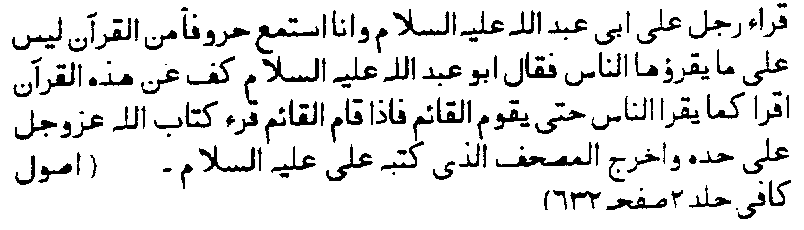
Translation:
A man said that someone was reciting the Quran in the company of Imam Ja'far. The
narrator said that he heard certain verses in the recitation which were not according to
the recitation of the people. Imam Ja'far told the person reciting: 'Do not recite like
this. Recite as the people recite until the (promised) Mahdi arrives. When the Mahdi
arrives, he will recite the Quran according to its original revelation and the Quran
compiled by Ali will be brought forward. (Ibid: 2.622)
One early Shi'ite commentator named Allamah Ali ibn Ibrahim Ali Qummi said regarding S. 3:32:
'The Imam said: 'The words: "The family of Muhammed" were also revealed along
with "the family of Ali Imran." They (referring to the Companions of the Prophet
S.A.W.) removed the words "The family of Muhammad" from the original text
(Tafsir Ali Qummi, p. 308)
Imam Ja'far is reported to have said that S. 20:115 originally included the following:

Translation:
"We had ordered Adam before with some words about Muhammad, Ali, Fatima, Hassan,
Hussain and the Imams from their offspring but he (Adam) forgot." Ja'far said: 'By
Allah, these were the words which were revealed to Muhammad.' (Usul Kafi, 1:416)
In Al-Qummi wrote, there is a report from Imam Ja'far regarding S. 12:49 that someone
recited this verse in the presence of Ali. Ali said:
'What will they press? Wine?' The person asked how he should read the verse. Ali
replied that the verse was revealed thus: "Then a year will come in which people will
he given abundant help and in which they will be given abundant rain." (Al-Qummi's
commentary, p. 192)

The word Ya'siroon in the present Quran is in the active voice. According to this
commentary it should have been read in the passive voice as Yu'saroon to alter the
meaning. In the footnotes to the translation of Maqbool, it is written that this word
(Ya'siroon) was changed from the passive voice to the active to suit the fancies of
wine-loving khulafa (rulers). (Maqbool's translation: 479)
Al-Qummi stated that Imam Muhammad Baqir said in regards to S. 47:9 that Gabriel
supposedly transmitted it in this manner:
'That is because they resented what Allah revealed about Ali.'
But then the apostates removed Ali's name (from the Quran). (Ibid., p. 1011)
Regarding S. 56:29:
"And the Companions of the Right Hand. What about the Companions of the Right
Hand. They shall be among thornless lote-trees and under clusters of bananas."
Al-Qummi tells us that:
One person recited this verse in the presence of Ali. Ali said that the word Talh is
not appropriate and should read Tal'a as in Surah Shu'araa. Some enquired as why the word
should not be changed. Ali replied that it was not the right time to do so because
correcting the Quran would only confuse common people. He went on to say that among the
Imams, only Imam Mahdi will have the right to reintroduce the Quran as it was during the
time of the prophet. (Ibid., p. 1067)
A prominent Shi'ite scholar of the 8th century A.H. wrote:

Translation:
'Enumerating the distortions and omissions of this sort (from the present Quran) would
become laborious and it will disclose what Taqiyyah (Shi'ite practice to conceal the
'truth' for religious purposes) requires me not to disclose: the good qualities of Allah's
friends and the vices of His enemies. (AI-Ihtijaj by Tibrisi, 1:254)
Mullah Muhsin Kashani, a 11th century A.H. Shi'ite scholar commented on the above statement:

Translation:
'It is clear from all of these traditions and quotations from the Family of the Prophet
that the present Quran is not the complete Quran which was revealed to the Prophet. In
fact, there are verses that contradict that which was revealed; verses that have been
distorted and places where omissions have been made such as the names of Ali, the Family
of Muhammad and, on several occasions, there were the names of the hypocrites. Moreover,
the present order of the Quran is not according to the preferred order of Allah and His
Messenger. Ali ibn Ibrahim (a renowned commentator) also holds this opinion.' (Tafseer
of Saafi, l:32)
Although we could easily produce more variant readings, these examples sufficiently put
to rest the erroneous claim that the Quran has been perfectly preserved from corruption
and variation. The Islamic traditions and MSS evidence conclusively demonstrate that the
Quran has suffered textual corruption by way of additions, omissions and conflicting
readings.
Articles by Sam Shamoun
Answering Islam Home Page